

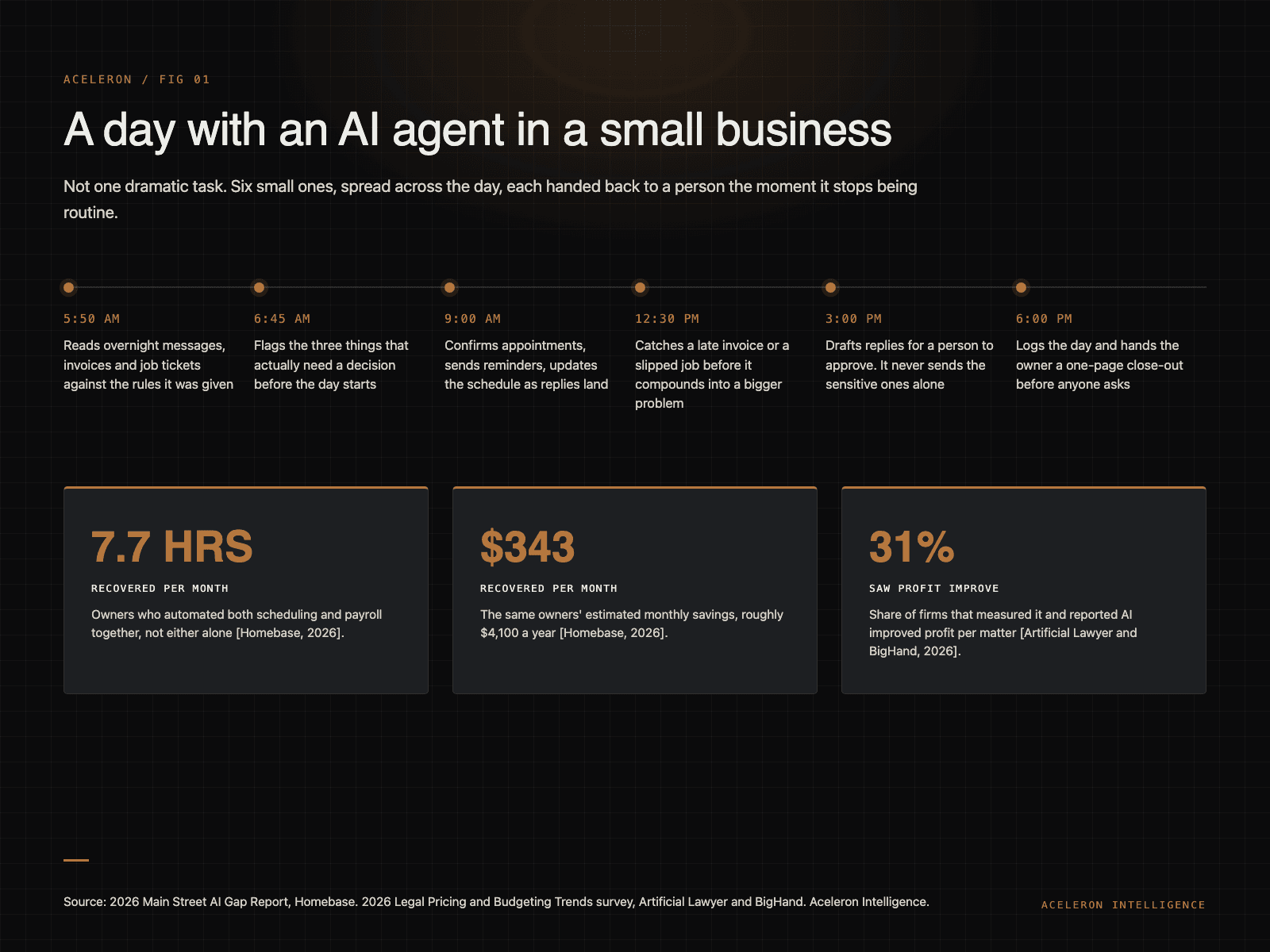
An AI agent in a small business does not do one dramatic thing. It does six small things, on a schedule, and hands each one back to a person the moment it stops being routine. This piece walks a real working day, hour by hour, across a few different kinds of businesses.
What this covers
- What arrives before anyone opens a laptop
- What an agent is allowed to decide alone
- What it always escalates
- How the same agent looks different by business
- What the owner actually sees at 7am
- Where the judgment stays human
What to weigh
- How much of your day is already a known rule
- Who gets the first look at an exception
- Which hour of the day costs you the most when it slips
- Whether the task needs speed or needs judgment
- How you will know the agent is actually working
By the end you will be able to name the three tasks in your own business that are routine enough to hand over this quarter, and the ones that should stay with a person for a long time yet.
Aceleron Intelligence builds private AI systems for law firms and local businesses in South Florida. This piece is written by our build team from engagements we have run in 2026.
01 / The landscape
Most owners picture an AI agent as a single clever assistant, something closer to hiring a very fast junior employee. The more accurate picture is a short list of standing instructions, checked continuously, against whatever the business already runs on. A 2026 survey of owners who use AI for both scheduling and payroll found they recovered an estimated 7.7 hours and 343 dollars a month, roughly 4,100 dollars a year, not from one big feature but from two ordinary tasks running without a person watching them [1]. That is the real shape of the work: small, frequent, and compounding.

The parts of the day that look the same everywhere
Strip away the industry and most small businesses run the same four shapes of work every day: something arrives, something needs a reminder, something needs a decision, and something needs a record kept. An agent is built against those four shapes, not against a job title.
- Messages, invoices, and job tickets arriving overnight
- Appointments and jobs that need a reminder before they slip
- A decision that has a clear right answer most of the time
- A log of what happened, written down without being asked
The owner's job stops being "read everything" and becomes "review the short list the agent could not resolve on its own." That is a smaller job, and a calmer one.
Why the hour before 9am matters most
A late invoice, a missed callback, or a double-booked job all cost the most when they are caught at 2pm instead of 7am. A separate 2026 report on the state of the US legal market found that close to 90 percent of legal work still runs through hourly billing, even as firms invest in AI, which means a partner who starts the day without yesterday's loose ends recovers that time directly, not abstractly [2]. A related 2026 survey found 31 percent of law firms that actually measured the result said AI improved profitability per matter, and the firms seeing that return had typically moved one specific morning task off a person's desk rather than bought more software [3].
- A trades business loses a job to a competitor who called back first
- A medical practice loses a slot that could have been filled
- A law firm loses billable minutes to morning triage
- A retail or restaurant owner loses the chance to reorder before a shift starts
The pattern holds across every one of them: the agent's value shows up before the business opens, not after.
02 / How to decide
The uncertainty most owners name is whether an agent can be trusted with a decision. The more useful question is which decisions were never a judgment call to begin with. The table below sorts a working day into the two buckets.
| Dimension | Agent handles it | Stays with a person |
|---|---|---|
| The kind of task | A rule with one right answer most of the time | A call with stakes, emotion, or ambiguity |
| What arrives overnight | Logged, sorted, matched against a threshold | Nothing, until a threshold is crossed |
| A late invoice | Flagged, a reminder drafted and queued | The decision to escalate, waive, or call |
| A new lead after hours | Logged, an acknowledgment sent | The actual sales or intake conversation |
| A frustrated message | Flagged immediately, nothing sent back | The reply, always written by a person |
| The day's close-out | Written in under two minutes | Read in under ninety seconds |
TABLE 01. WHAT THE AGENT HANDLES VS WHAT STAYS WITH A PERSON.
The single move that matters most is writing the threshold down before the agent ever runs. A dollar figure, a day count, or a word in a message that forces a human look, decided once with the owner, in plain language. Our services page walks through how we set that threshold with a client before anything is wired in.
Practical checks
- Count how many of today's messages were a known rule before you read them. For most owners it is 60 to 80 percent.
- Time how long the daily close-out takes to read. If it is over five minutes, the agent is reporting everything instead of what changed.
- Name the dollar figure that should force a human look on a late invoice or an unusual charge, in writing, before the agent runs.
- Pick one task this month, not six. A single automation that actually ships beats a roadmap that does not.
Routine vs judgment
Routine is a task with a right answer most of the time, the kind a competent employee would do the same way twice in a row without needing to think hard. Judgment is a call that depends on who is involved, what else is happening, or what the business is willing to risk.
The reader whose day is mostly routine, high volume, and repeatable should start an agent this quarter. The reader whose day is mostly judgment, low volume, and relationship-driven should automate the paperwork around that judgment instead of the judgment itself.
03 / Where this fits
The shape of the day changes by business, even when the underlying four tasks do not.

- A trades or home-services business: the agent logs jobs, confirms the next day's schedule, and flags a part that needs reordering before the truck leaves.
- A medical or dental practice: the agent confirms appointments, flags a form that came back incomplete, and never touches a clinical decision.
- A law firm or accounting practice: the agent handles intake and billing reminders while the actual advice stays entirely with the professional.
Starter, standard, full build
- Starter: one task, one channel, one person reading the result. Two weeks is enough to prove the loop actually runs.
- Standard: three to five tasks working together, with a twelve-week window to let the thresholds settle against real volume.
- Full build: the agent runs across most of the business's routine work, reviewed quarterly, and the owner's day becomes mostly exceptions by month six.
Making it fit your business
- Choose the hour the agent reports in against your actual first decision of the day, not a round number.
- Set the dollar or day threshold that earns a human look, in writing, with the owner, before anything ships.
- Decide which channel the report lands in. An agent that reports somewhere nobody opens is not running at all.
04 / How Aceleron builds this
Most of the owners we meet have already tried a general chatbot subscription bolted onto their existing tools. It answers questions well enough, but it does not run on a schedule, does not know the business's own thresholds, and forgets the context between sessions. We build the other way around: a standing agent, grounded in the business's own records, that runs on hours a person actually cares about.
- The agent is built against the business's own four shapes of daily work, not a generic template.
- Every threshold that triggers a human look is written down with the owner before the agent runs on real data.
- The agent runs inside the business's own environment, so client files, patient records, and financial data never leave the building.
- Every day's run is logged, so what the agent decided and what it escalated is a written record, not a guess.
An agent does not do one dramatic thing. It does six small things, on a schedule, and hands each one back to a person the moment it stops being routine.
- Aceleron Build Team, 10.2026
How to get the most out of this
- Start with the task that costs you the most when it slips, not the one that sounds the most impressive.
- Write the escalation threshold in plain English before the agent ever touches live data.
- Review what the agent caught and what it missed every two weeks for the first quarter. Our dashboard page shows how that review stays to fifteen minutes, not an hour.
- Expect the second task to take half the time the first one did. The thresholds you already wrote tend to transfer.
05 / FAQ
What does an AI agent actually do in a small business?
It reads what arrived since the business last closed, checks it against rules the owner set, handles what matches a rule, and flags what does not. A good agent produces a short list a person can review in under two minutes, not a dashboard a person has to dig through.
How is an AI agent different from an automation?
An automation follows one fixed path every time: if this, then that. An agent reads a wider range of inputs, including ones phrased differently each time, and decides which of several known responses fits. Most small businesses need both, starting with the automation and adding an agent where the input varies too much for a fixed rule.
Does an AI agent run the whole day without anyone watching it?
No. It runs continuously, but it is built to stop and hand off the moment a threshold is crossed, a message reads as upset, or a decision carries real stakes. The goal is not an unattended business. It is a shorter list of things that actually need a person's attention.
What is the first task to hand to an agent?
The one that costs the most when it slips and happens the most often, which for most small businesses is overnight messages, late invoices, or appointment confirmations. A single working automation this month beats a six-task plan that never ships.
References
[1] 2026 Main Street AI Gap Report: Who's Adopting AI (and Who's Not). Homebase. 2026-09-22. https://www.joinhomebase.com/blog/small-business-ai-gap-report.
[2] 2026 Report on the State of the US Legal Market. Thomson Reuters Institute and Center on Ethics and the Legal Profession at Georgetown Law. 2026-01-07. https://www.thomsonreuters.com/en/institute/reports/state-of-the-us-legal-market-2026.
[3] 31% of Law Firms Say AI Improves Profitability, reporting on the 2026 Legal Pricing and Budgeting Trends survey. Artificial Lawyer and BigHand. 2026-09-16. https://www.artificiallawyer.com/2026/09/16/31-of-law-firms-say-ai-improves-profitability/.
Conclusion
An AI agent in a small business is not a single impressive feature. It is a short, written list of what counts as routine, checked continuously, with everything else handed straight to a person. Start with the one task that costs you the most when it slips, write the threshold down, and let the rest of the day get quieter from there.
Book a free discovery call. We map where your hours and dollars go, then hand you a customized implementation plan. No cost, no obligation, and no public cloud chatbot in the loop. Grab a 30-minute slot at book.aceleron.ai/intro-30, or start with a note on our contact page.