

A good AI daily brief for business is five things that changed overnight. Not a dump of your inbox, not a list of every number the business tracks, and not another tab you forget to open by Thursday.
What this covers
- What a daily brief should contain
- Why five beats fifty
- What a brief is built on
- Who reads it in your firm
- How the brief should evolve
What to weigh
- The hour the brief lands
- The channel it arrives on
- Which signals cross the threshold
- Who writes those thresholds
- What the brief deliberately leaves out
By the end you will know whether to buy a brief, build one, or redesign the one you already have, and what the first version actually says on Monday morning.
Aceleron Intelligence builds private AI systems for law firms and local businesses in South Florida. This piece is written by our build team from engagements we have run in 2026.
01 / The landscape
The problem is not that owners and partners lack information. It is that they drown in it. Microsoft's 2026 Work Trend Index Annual Report surveyed 20,000 knowledge workers who use AI at work and found 65 percent fear falling behind if they do not adopt it quickly, while 66 percent said AI has let them spend more time on high-value work [1]. That is a workforce that already senses the input volume has outrun the hours, and the gap keeps widening.

The business cost is specific. The 2026 Report on the State of the US Legal Market from the Thomson Reuters Institute and Georgetown Law found that about 90 percent of legal dollars still move through hourly billing arrangements, even as firms invest aggressively in AI [2]. A partner who recovers fifteen minutes of morning triage recovers billable minutes, directly. A service-business owner who starts the day on the one job that slipped last night recovers margin that would have evaporated by lunch.
The problem is not access, it is attention
The usual response to too much information is a new dashboard. Six months later the dashboard is a sixth tab the owner does not open. The missing layer is attention, not access.
- Inboxes carry fifty threads that are all marked urgent
- Dashboards describe steady state, not what changed
- Alerts fire at thresholds nobody calibrated
- Field reports arrive hours after the decision window closed
A brief inverts that stack. It assumes the business already knows how to run on a quiet day. It only speaks when something moved.
Why 2026 is the year the brief matters
A separate 2026 pricing and budgeting survey of law firms reported by Artificial Lawyer and BigHand found 31 percent of firms that scrutinised their data said AI had improved profitability per matter, and 31 percent reported reduced reliance on manual work [3]. The firms booking a return are not the ones who bought more software. They are the ones who moved a specific morning task off a person and into a system.
- Hourly firms gain the time directly, in billable minutes
- Fixed-fee firms gain capacity on the same headcount
- Service businesses move the first call of the day earlier
- Every operator gains clearer thinking before 9am
The result is the same across industries. The brief is where the compounding starts.
02 / How to decide
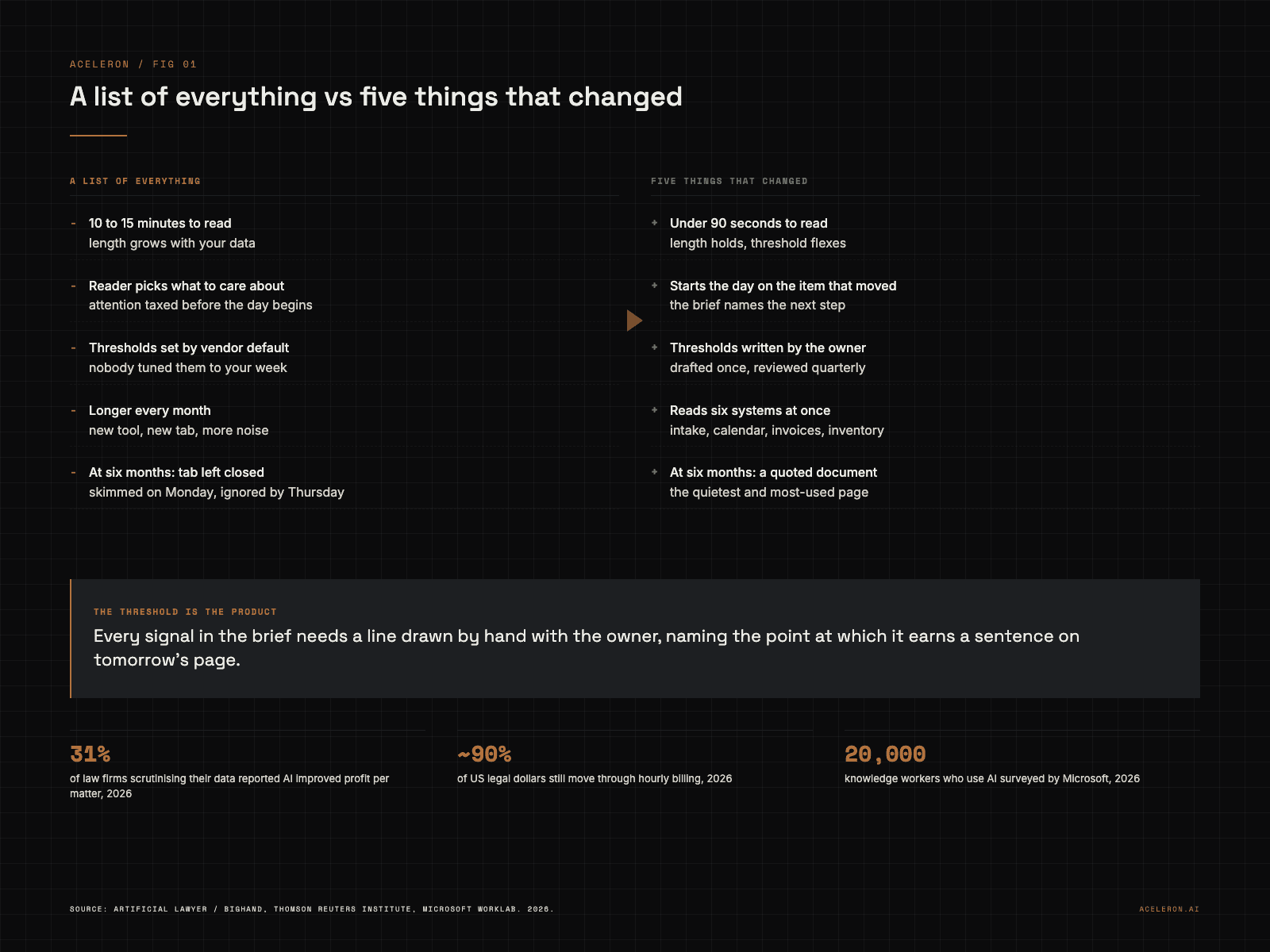
The uncertainty most owners name out loud is what the brief should contain. The real question is what it leaves out. The following table sets the two postures side by side, because the choice between them is the whole product.
| Dimension | A list of everything | Five things that changed |
|---|---|---|
| What it answers | What is happening | What is different, and why it matters |
| How long it takes to read | 10 to 15 minutes | Under 90 seconds |
| What the reader does next | Picks what to care about | Starts the day on the item that moved |
| What breaks under volume | Longer list, slower read, less used | Threshold flexes, length holds |
| Who writes the thresholds | Nobody, so defaults win | The owner, once, then revisited quarterly |
| How it ages at six months | A tab left closed | A document people quote |
TABLE 01. A LIST OF EVERYTHING VS FIVE THINGS THAT CHANGED.
The single move that matters most is thresholding. The brief is defined by its filters, not by its template. A number of calls, dollars late, days of inventory, hours worked, open matters past a deadline: every signal in the brief needs a line drawn by hand, with the owner, naming the point at which it earns a sentence on tomorrow's page.
Practical checks
- Write the threshold for every signal in the brief by hand with the owner before the first send, and date the page.
- Time the brief end to end at the hour it lands. Target under 90 seconds. If it reads longer, the length is wrong, not the hour.
- Flag any signal that has fired zero times in the last 30 days. It belongs out of the brief, or the threshold is wrong.
- Cap the maintenance cost at 15 minutes of knowledge-worker time a week. Above that, the brief is pretending to be a dashboard. Our walk-through of that measurement sits on the dashboard page.
Noise vs signal
The distinction is simple to state and hard to hold. Noise is anything the business already knew. Signal is anything a well-run team would want to adjust by lunch. A brief that mixes the two trains the reader to skim, and a skimmed brief is a dashboard with better typography.
The reader who should buy a brief has a running operation and a clear sense of their normal week. The reader who should start with a dashboard is still building the baseline and wants the shape of the quiet day on one page. Buy the brief after you can describe the quiet day in a sentence, not before.
03 / Where this fits
The daily brief lands in a different place in every business, which is why a one-size template fails on contact.
- A law firm partner's brief: new matters that came in overnight, deadlines moving inside the next 72 hours, retainers running low, and one open conflict check waiting on a human call. Five lines, with the owner's name attached to each.
- A service-business owner's brief: jobs that slipped on time, invoices crossing 30 days overdue, inventory below the reorder line, one callback flagged for the owner, and the day's cash number.
- An operations lead's brief: the three KPIs that moved more than a standard deviation yesterday, the one process that produced an exception the automation could not resolve, and the person a decision is sitting on.
Starter, standard, full build
- Starter: one signal, one channel, one reader. Usually email or a chat message at 7am naming the single number that moved. The point is to prove the loop. Two weeks is enough.
- Standard: five signals, one brief, one reader. Twelve weeks is the window we use to let thresholds settle, because the first month tells you where the defaults are wrong.
- Full build: three to five briefs across a business, each tuned to a role, with monthly review sessions that redraw the thresholds. At six to twelve months the brief is the quietest and most-cited document in the operation.
Making it fit your business
- Pick the channel the reader already lives in. A brief in a tool nobody opens is a brief nobody reads.
- Set the hour against your actual first decision of the day, not a round number. If the first client call lands at 7:15, the brief lands at 6:55.
- Keep veto power for the owner. The brief says what changed; the owner still decides what to care about.
04 / How Aceleron builds this
Most owners we meet have already tried a dashboard, and a few have tried a chatbot on top of it. Neither moved the needle, because neither was shaped against a specific reader at a specific hour. We start the other way around.
- The brief is written for one named reader at one named hour, and the agent is built against that specification before any signal is wired in.
- Thresholds are drafted in a 60-minute session with the owner, written in plain English, and reviewed quarterly against what actually fired.
- Every signal in the brief traces back to a system the business already runs, so there is nothing new to log into and nothing new to maintain.
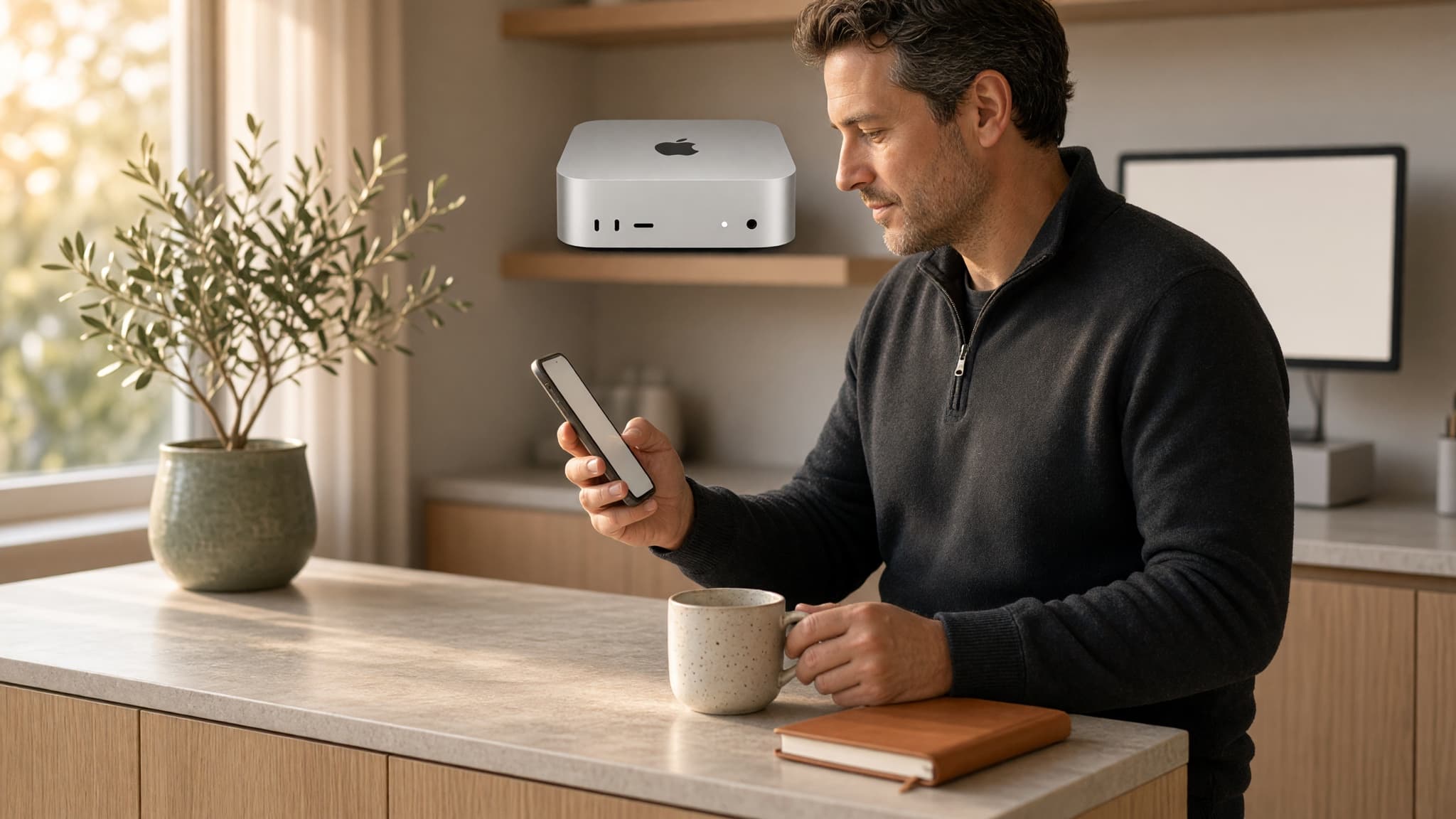
- The agent runs inside the client's own environment on hardware they own, so case files, invoices and client messages never leave the building.
A brief that reads in under 90 seconds and names nothing the reader already knew is worth more than a dashboard that answers every question nobody asked.
- Aceleron Build Team, 10.2026
How to get the most out of this
- Pick a reader and an hour before anything else. The brief's first draft should carry a name and a time on it, not a feature list.
- Draft the thresholds in a single session, out loud. Where the owner cannot name the line, there is no signal yet, only a hope.
- Keep the brief inside a channel the reader already opens before 8am. Our services page describes the integrations we use most often, and the point is that none of them is new.
- Review the thresholds every ninety days against what fired and what did not. The brief that still reads in under 90 seconds a year in is the brief that was tuned twice along the way.
05 / FAQ
What is an AI daily brief for business?
A short morning note that names the small number of things that changed since yesterday, built by an agent that reads the systems the business already runs. The target shape is five items, under 90 seconds end to end, delivered at a named hour on a channel the owner already opens. It is not a dashboard, and it is not a chatbot. It is a one-page document the business can quote.
How is a daily brief different from a dashboard?
A dashboard describes steady state and leaves the reader to find what moved. A brief does the finding, and only speaks when the signal crosses a threshold the owner wrote. The dashboard still has a place for the baseline view and the quarterly numbers; the brief is for the morning decision.
What should an AI daily brief include?
Only signals the business can act on inside the day. For a law firm that usually means new matters, moving deadlines, retainer balances and one conflict check. For a service business it is late invoices, slipped jobs, inventory, callbacks and cash. Every item names the reader who owns the next step, so the brief ends with an action and never with a question.
Who writes the thresholds?
The owner, in a working session with the build team, before the first brief ships. Thresholds set by vendor defaults or by a quick guess during setup are the single most common reason a brief degrades to a tab nobody opens. Revisit the thresholds every quarter against what actually fired.
Does a daily brief need AI?
Not in principle. A long-tenured assistant with a routine can produce the same shape. In practice an agent is cheaper to run, operates at 6am, reads six systems at once, and does not call out sick. The AI is a means. The brief is the product.
References
[1] 2026 Work Trend Index Annual Report: Agents, human agency, and the opportunity for every organization. Microsoft WorkLab. 2026-05-05. https://www.microsoft.com/en-us/worklab/work-trend-index/agents-human-agency-and-the-opportunity-for-every-organization.
[2] 2026 Report on the State of the US Legal Market. Thomson Reuters Institute and Center on Ethics and the Legal Profession at Georgetown Law. 2026-01-07. https://www.thomsonreuters.com/en/institute/reports/state-of-the-us-legal-market-2026.
[3] 31% of Law Firms Say AI Improves Profitability, reporting on the 2026 Legal Pricing and Budgeting Trends survey. Artificial Lawyer and BigHand. 2026-09-16. https://www.artificiallawyer.com/2026/09/16/31-of-law-firms-say-ai-improves-profitability/.
Conclusion
The businesses that get a return from AI in 2026 are not the ones with the longest dashboards. They are the ones who decided, in advance, which five things the morning should speak about and set the thresholds themselves. Start the brief, set it against a named reader at a named hour, and the rest of the stack starts to pay for itself.
Book a free discovery call. We map where your hours and dollars go, then hand you a customized implementation plan. No cost, no obligation, and no public cloud chatbot in the loop. Grab a 30-minute slot at book.aceleron.ai/intro-30, or start with a note on our contact page.