

Human at the helm means a person decides, before the work starts, which calls belong to them and which ones an AI system can run on its own. It is the difference between a firm that books the savings and a firm that owns another subscription.
What this covers
- What the 2026 profitability numbers actually say
- Why in the loop and at the helm are not the same
- Which decisions stay with a person
- How to size a first bet instead of scattering tools
- What this looks like in businesses we have built for
What to weigh
- Which part of the work is genuinely routine
- Where judgment is the product you sell
- Who writes the brief before the machine runs
- How a role changes when its tasks move
- What you will measure to know it worked
By the end you will be able to draw the line through your own operation between the work a system should take and the work a person should keep. This piece is written by the Aceleron build team from engagements we have run in 2026.
Aceleron Intelligence builds private AI systems for law firms and local businesses in South Florida. Every borrowed claim below is cited to a primary source.
01 / The landscape
The returns are real and they are unevenly distributed. A 2026 pricing and budgeting survey by BigHand found that 31 percent of law firms that had actually scrutinised their data said AI improved profitability per matter, and 30 percent saw higher matter throughput [1]. The same survey found 27 percent reporting a reduction in billable hours on certain tasks and 31 percent a reduced reliance on manual work [1]. Those are firms measuring an outcome, not firms describing a purchase.

There is a structural tension underneath those numbers. The 2026 Report on the State of the US Legal Market found that roughly 90 percent of legal dollars still move through hourly billing arrangements [3], which means efficiency only converts into profit for a firm that has decided in advance how it will capture the time it saves.
Read the number the other way and it is a warning. Roughly two thirds of firms could not point to a profitability gain. The tooling in those firms is frequently the same tooling. What differs is whether anybody decided, in advance, what the machine was for.
The measurement gap is part of the story
BigHand's own note on the data is worth repeating: some firms did not answer in the affirmative simply because they are not tracking the numbers required to answer at all [1]. A firm that cannot say what intake cost last quarter cannot say whether automation improved it. The first work in most engagements is not automation. It is instrumentation.
- Name the workflow and who touches it
- Count the hours it consumes today
- Record the baseline before anything changes
- Re-measure the same way after
A business that skips the baseline is choosing, on day one, never to know whether the investment paid. That is the most common self-inflicted wound we see.
Adoption is not the same as advantage
The survey also found 35 percent of partners uncomfortable discussing AI use with clients [1]. That discomfort tends to track the same gap: a firm confident about where its automation starts and stops has an easy answer for a client, because it can describe what a person still decides. A firm that bolted a chatbot onto a workflow has a harder conversation, because the honest answer is that nobody drew the line.
02 / How to decide
The distinction that matters is not which model you buy. It is where the human sits relative to the work. Most organisations default to what sounds responsible, a human in the loop, and end up with a person rubber-stamping output they did not shape and cannot realistically check.
Paula Goldman, Salesforce's chief ethical and humane use officer and author of Manage the Machine, made the case on HBR IdeaCast in September 2026 for a different posture [2].
| Dimension | Human in the loop | Human at the helm |
|---|---|---|
| When the person engages | After the output exists | Before the work is scoped |
| What the person supplies | Approval | Judgment, criteria, the brief |
| What happens under volume | Review degrades into rubber-stamping | The rules hold, because they were set once |
| Where errors surface | At the end, if someone catches them | At the boundary the person drew |
| What the business can defend | That a human clicked approve | Which decisions were never the machine's |
TABLE 01. HUMAN IN THE LOOP VS HUMAN AT THE HELM.
The one move that matters most is doing the split before deployment rather than after. A person who writes down which decisions are theirs is governing the system. A person handed a queue of finished output is processing it, and will get faster and less careful as the queue grows.
Practical checks
- Write the routine and judgment split on one page before any tool is configured, and have the owner sign it.
- Confirm every automated step can be traced, so a client question has an actual answer rather than a shrug.
- Set the escalation trigger on emotional stakes, not just task complexity. A distressed caller is a human moment even when the request is simple.
- Record the baseline hours for the workflow before go-live, then re-measure at 30 and 90 days against the same definition.
Our own position on where that boundary sits, and what we will not automate, is set out on the services page.
The 70 and the 30
Goldman's working estimate is that AI can carry a leader roughly 70 percent of the way on many decisions, with the remaining 30 percent resting on context a system cannot see: emotion, sensitivity, who is in the room, what is actually at stake [2].
That split is a scoping instrument. For a professional-services firm, the 70 is the structured work in front of the judgment: reading the incoming document, pulling the dates, checking them against a rule, putting the result where a person will see it. The 30 is the call itself. A firm that automates into the 30 loses the thing clients pay for. A firm that refuses to automate the 70 pays people to do arithmetic.
03 / Where this fits
The line lands in a different place in every business, which is the whole point of drawing it deliberately rather than accepting a vendor's default.

- Litigation practices: the deadline math, docket reading and calendar entry are routine and unforgiving, so they belong to the system. Which motion to file and how hard to push a continuance is the practice of law, and stays with the lawyer.
- Transactional and estate work: the intake form, the first draft and the funding checklist are patterned work a system does well. Advising the client and signing the instrument does not move.
- Field and trade businesses: scheduling, dispatch confirmation and invoice follow-up run themselves. Pricing a difficult job and handling an unhappy customer is where the owner's judgment earns its keep.
Starter, standard, full build
- Starter: one workflow, one decision boundary, one measured baseline. The goal is a number you trust by week six, not a broad rollout.
- Standard: three to five workflows inside a 12-week window, sharing one knowledge base, with the escalation rules written once and applied across all of them.
- Full build: several agents running the routine layer of the operation, with a live view of hours recovered week over week. See what that view looks like on the dashboard walkthrough.
Making it fit your business
- Choose the escalation trigger you actually trust, and include emotional stakes in it, not only task difficulty.
- Choose how much first-draft latitude the system gets. More latitude means faster output and more editing.
- Choose what gets measured, and keep the definition stable. A baseline that moves proves nothing.
04 / How Aceleron builds this
Most owners we meet have already tried something. A subscription went out to the whole office, a few people used it for a month, and nothing measurable changed. The friction is rarely the model. It is that nobody decided what the machine was responsible for, so it became responsible for nothing in particular.
We start with the boundary, then build to it.
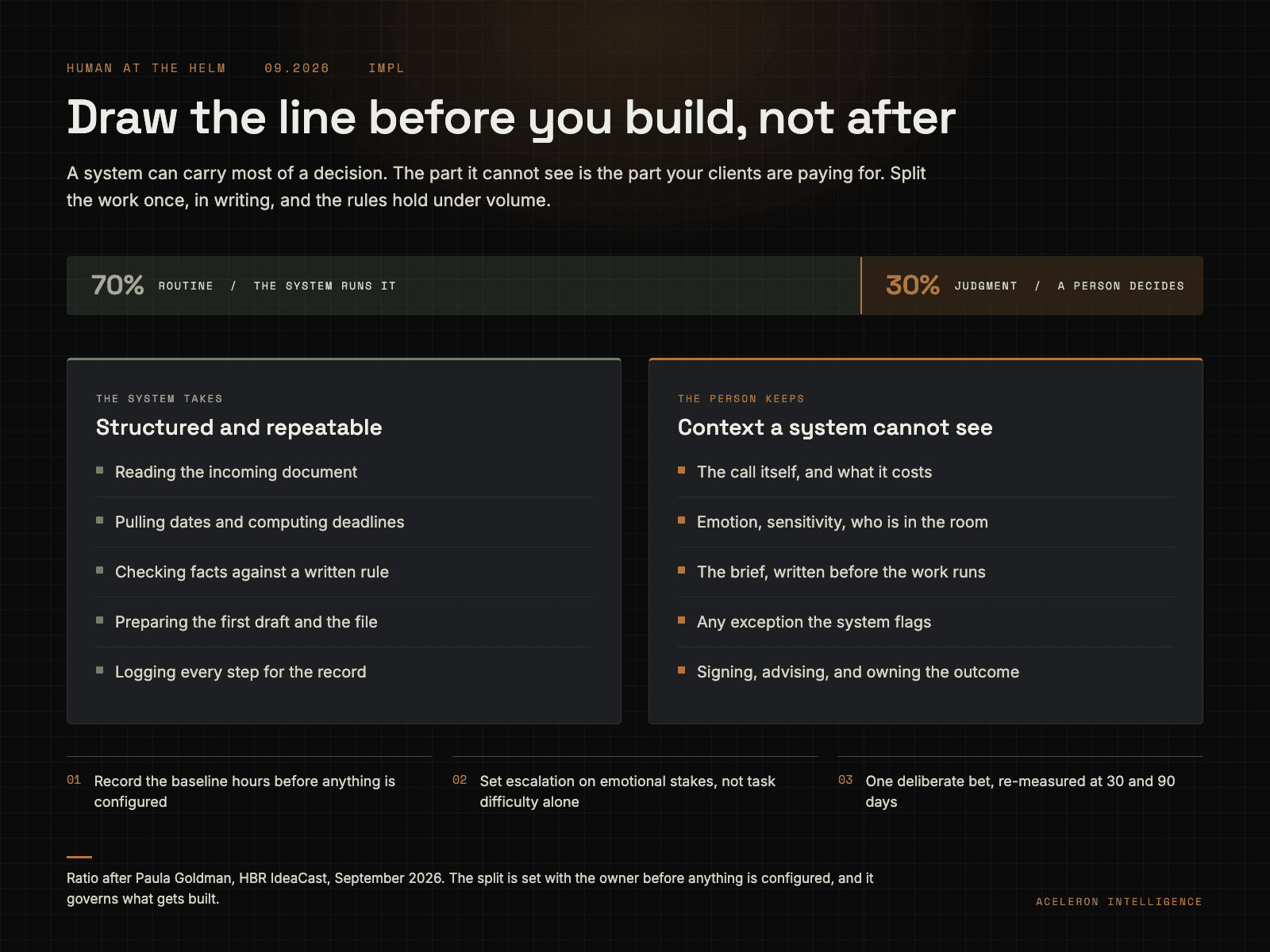
- The routine and judgment split is written down with the owner before anything is configured, and it governs what gets built.
- Systems run inside the client's own environment on hardware they own, so the boundary is physical as well as procedural.
- Every automated step is logged, so the business can describe its own process to a client or a regulator.
- A small number of deliberate bets, sized to a named cost, instead of licences scattered across a firm.
A firm that automates into the judgment loses the thing clients pay for, and a firm that refuses to automate the routine pays people to do arithmetic.
- Aceleron Build Team, 09.2026
How to get the most out of this
- Start with the workflow that already has a written checklist. Where a process is tribal knowledge, write it down first; that document is most of the build.
- Make one deliberate bet rather than four hopeful ones. Scattered spend produces scattered results and no clean read on what worked.
- Front-load the brief. Goldman's IKEA example is a design team that kept getting conventional output until they put their own ideas in first [2]. Set the thesis, then let the system run.
- Track hours returned and exceptions escalated, and watch both on the dashboard. Everything else is decoration.
05 / FAQ
What is the difference between human in the loop and human at the helm?
In the loop describes a person reviewing output after a system produces it. At the helm describes a person deciding, in advance, which categories of decision belong to people and which can run automatically. The first degrades into rubber-stamping as volume rises. The second holds, because the rules were set once and are enforced by design.
Does AI replace roles or tasks?
Goldman's position on HBR IdeaCast is that AI is generally tasks rather than entire roles [2]. That matches what we see in delivery. In an estate-planning practice we built for, the same attorneys do the same jobs; the intake form, the first draft and the funding checklist arrive already prepared. The task moved. The role did not.
How do I know whether AI is actually improving profitability?
Measure the workflow before you change it. BigHand's 2026 survey explicitly notes that some firms could not report a gain because they were not tracking the data needed to answer [1]. Record the baseline hours, keep the definition stable, and re-measure at 30 and 90 days.
Where should a business make its first bet?
Pick the workflow that is routine, high volume, already written down, and currently consuming someone's week. That combination produces a measurable result fast and gives the organisation a real reference point for the next decision.
What should never be automated?
Anything where the judgment is the product, and anything where a person needs to be met by a person. An angry or distressed client is a human moment regardless of how simple the underlying request looks, and that belongs in the escalation rule from day one.
References
[1] 31% of Law Firms Say AI Improves Profitability, reporting on the 2026 Legal Pricing and Budgeting Trends survey. Artificial Lawyer and BigHand. 2026-09-16. https://www.artificiallawyer.com/2026/09/16/31-of-law-firms-say-ai-improves-profitability/. Report: https://www.bighand.com/en-gb/resources/whitepapers/2026-legal-pricing-and-budgeting-trends-analysis/.
[2] How AI Is Changing Talent, Not Just Tasks: Rethinking Where Human Judgment Matters Most, with Paula Goldman. HBR IdeaCast, Harvard Business Review. 2026-09. https://hbr.org/podcast/2026/09/how-ai-is-changing-talent-not-just-tasks-rethinking-where-human-judgment-matters-most.
[3] 2026 Report on the State of the US Legal Market. Thomson Reuters Institute and Center on Ethics and the Legal Profession at Georgetown Law. 2026-01-07. https://www.thomsonreuters.com/en/institute/reports/state-of-the-us-legal-market-2026.
Conclusion
The firms booking a return from AI are not the ones who bought earlier or bought more. They are the ones who decided what the machine was for before switching it on, and kept the decisions that were always theirs. Draw that line in your own operation and the technology question mostly answers itself.
Book a free discovery call. We map where your hours and dollars go, then hand you a customized implementation plan. No cost, no obligation, and no public cloud chatbot in the loop. Grab a 30-minute slot at book.aceleron.ai/intro-30, or start with a note on our contact page.