
AI assistants recommending local businesses pick one shop, not a list of ten links, and the pick comes from three inputs: a consistent business profile across the web, recent reviews, and plain facts on your own site [1][2]. In Miami or anywhere in Florida, the first move is adding an AI assistant option to the how-did-you-hear-about-us field, so you can tell when one sends you a customer.
What this covers
- How the pick is actually scored
- Where AEO sits next to local SEO
- A thirty-day tracking setup
- The one intake-form fix nobody runs
- What a Miami shop does first
What to weigh
- Whether your Google profile matches your site
- How many 2026 reviews you have
- What your front desk script asks
- Who owns the follow-up
By the end you will name the three things an AI assistant looks at before it names your business, run a 30-day baseline without a new tool, and know what to build yourself. As of October 2026, few small business owners we meet in South Florida can answer those questions, and the fix is cheaper than any software they already pay for.
Aceleron Intelligence builds private AI systems for law firms and local businesses in South Florida. This piece is written by our build team from engagements we have run in 2026.
01 / What makes an AI assistant recommend one small business over another?

Nearly half of US consumers now ask an AI assistant for local recommendations: 45 percent of adults said they had used a generative AI tool to find a local business in a BrightLocal survey published in February 2026 [1]. On the other side, 86 percent of small business owners already know their customers do it, and 23 percent now rank AI as a top-two source of new customers [1]. Most owners still cannot see which new customers walked through the pipe.
What is an AI assistant actually doing when it picks one business?
The pick is a passage-level citation. An assistant runs a live search, pulls three to seven pages, scores each passage, and composes a short answer naming one or two businesses with phone and address. Getting into that answer is about 30 times harder than ranking in Google's local pack, and fewer than half of the shops at the top of Google's local pack also appear in AI local recommendations [1].
- Profile match: name, address, phone and hours agree across your site, Google Business Profile and the major directories
- Review signal: recommended businesses in a 2026 index averaged 4.3, 4.1 and 3.9 stars across three major assistants [1]
- Citable facts on your site: service area, prices, hours, licensing and specialties, in plain text an engine can quote
- Freshness: an assistant lifts text with recent dates ahead of older material
A shop strong on two of the four loses the pick to a competitor average on all four.
What AI assistants actually read
The ranking inputs are the ones a human would check if they called around. The engine does it in two seconds across the whole web, which rewards the shop that already made the information easy to find. In a 2024 study of AI assistant local sources, 58 percent of citations came from business websites, 27 percent from mentions on other sites, and 15 percent from directories [1]. Your own site is the biggest contributor, which is good news for a small business owner.
02 / Answer engine optimization or local search engine optimization: which does a Miami shop start with?
Owners we meet in Miami, Fort Lauderdale and West Palm Beach are stuck on whether answer engine optimization is a separate project from the local search engine optimization (SEO) they already pay for. The two largely overlap; the slice that is different is where a small business wins or loses the recommendation.
| Dimension | Local SEO only | Answer engine optimization added |
|---|---|---|
| Who it is written for | A person scanning a map pack | An assistant lifting a passage |
| What it needs | Keywords, backlinks, star rating | Short answers under question-shaped headings |
| What it reads from | Google Business Profile, map embeds | Your own site plus directories, cross-checked |
| How a win shows up | Position in the map pack | Named in the one-shot answer |
| Cheap to fix in a week | Reviews, hours, categories | Intake-form question, FAQ page |
TABLE 01. AEO AND LOCAL SEO FOR A SMALL BUSINESS, SIDE BY SIDE.
The single best move before you spend a dollar on a new tool is to open your Google Business Profile, your website footer and the directories you are listed in, and make the name, address, phone and hours identical across every one. Only 68 percent of local business contact details on major AI assistants matched the businesses' own Google profiles in a 2026 index [1]; a third of recommended businesses are being named with partially wrong information. An owner who fixes that in an afternoon leapfrogs most of the market.
Practical checks
- Open your Google Business Profile and your website side by side; the hours, phone and service area must match to the character.
- Pull the last 30 reviews and count how many are from 2025 or later. Fewer than 15 recent reviews is the signal to put a review-ask into your closing call script this week.
- Walk a fictional caller through your site: can an engine lift your service area, price range, license number and hours from your pages, in plain text, without a dropdown?
- Add an AI assistant option to your how-did-you-hear-about-us field, in the intake form and the front desk script. Across 1,215 US enterprise domains in 2025, AI referral traffic was 1.08 percent of visits and converted 42 percent better than other traffic in a March 2026 Adobe benchmark [2][3].
Our services page walks through how we scope one of these in a two-week window before the owner commits.
AEO on top of what you have, or a separate retainer
The cheaper path is to layer AEO on top of what already works. Fix the profile mismatches first, add three question-shaped headings to the services page, add a short Miami-neighborhoods paragraph, add the intake tracking line. One week of work, no new vendor.
A dedicated AEO retainer makes sense once a business is past two million dollars of revenue and competing with ten or more similar shops in the same neighborhood. For a smaller shop, run the simple pass for 90 days and only hire a retainer if the baseline shows AI-assistant traffic worth growing.
03 / Is it worth optimizing for AI assistants when you already rank on Google?

Yes, for most Miami small businesses, with a caveat. AI referral traffic is still a thin slice: Similarweb put the June 2025 to May 2026 global volume at 770.7 million visits a month, growing 117.4 percent year over year, and SE Ranking measured the AI share of visits at 0.32 percent in the first four months of 2026 [3]. The traffic is small. The conversion is not: AI-referred visitors spend 68 percent more time on site, and in a 2026 Adobe benchmark converted 42 percent better than all other traffic [3]. Low-volume, high-intent traffic is the shape every owner says they want.
- Home services in Doral or Hialeah: fix the three profile mismatches, then publish one plain-language FAQ page on your top three services. The engine that quotes your competitors can quote you.
- A medical or dental practice in Coral Gables: AEO is a content exercise, not a data move. Fee ranges, specialty descriptions, insurance accepted, and a question-shaped FAQ.
- A professional services firm in Brickell: pair AEO with named author pages. A short bio with credentials, linked both ways with the firm site, is a high-return addition in 2026.
Starter, standard, full build
- Starter: a one-week pass that fixes profile mismatches, adds the intake question, and ships three question-shaped FAQ sections, measured against a 30-day baseline.
- Standard: a twelve-week window that runs the Starter pass, publishes six to eight AEO posts tied to real local questions, and installs a weekly brief with AI-referred visits and new-customer count.
- Full build: Starter and Standard plus a private on-site agent that counts AI-referred customers against the baseline and surfaces where the business is misnamed. See the dashboard page for the shape.
Making it fit your business
- Pick the service area yourselves. Name three Miami-Dade, Broward or Palm Beach neighborhoods you want the next ten customers from, and write for those by name.
- Decide what the FAQ answers in a sentence and what it hands to a person. Pricing ranges on the page; a specific quote stays with the owner.
- Name who owns the Monday brief. One person with authority to change the service page copy.
04 / How does Aceleron Intelligence set up AI assistant tracking for a Miami small business?
Most Miami small business owners we talk to have already tried to measure this and hit the same wall. Google Analytics shows a line called "AI assistants" with four visits a month, nobody at the front desk is asking the question, and the owner cannot tell if yesterday's new client was sent by a search, a barbecue conversation or an answer engine. The data lives in the first thirty seconds of every new customer call; nobody is writing it down. Aceleron closes that gap by making the question part of the intake, and the intake part of a private agent that counts automatically.
- Every build starts with a baseline week: current new-customer intake sources, before any AI tracking runs
- The agent reads your intake form, call log and receptionist notes where they already live, adds the AI assistant option, and summarizes the week in one brief
- A Monday brief lands on the owner's phone with the AI-referred customers, named by assistant, with the dollar line each one is worth
- Customer data stays on a small on-site machine and never leaves the building, which keeps caller names and phone numbers out of a public cloud chatbot
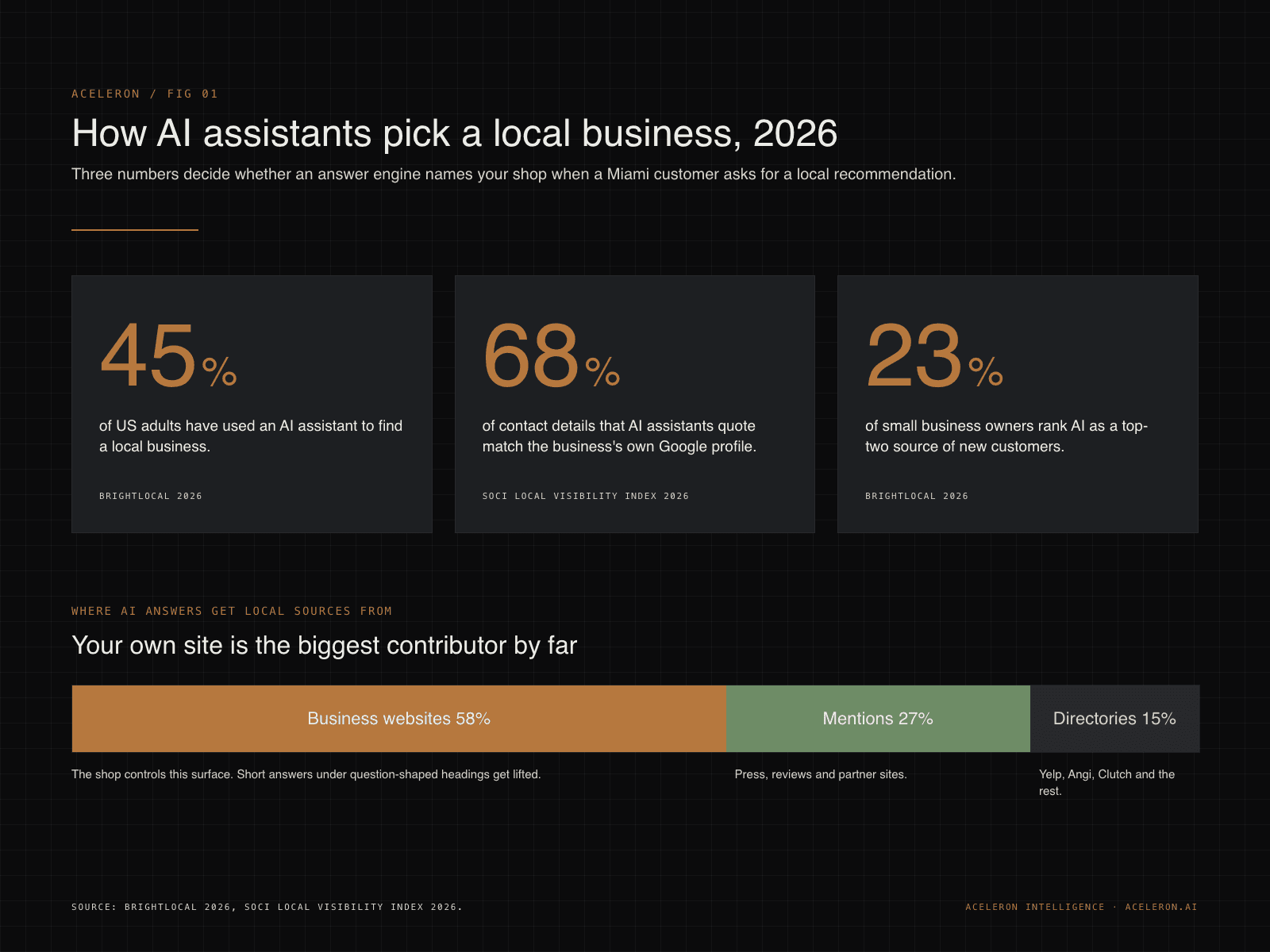
Three 2026 numbers decide the pick: 45 percent of US adults have used an AI assistant to find a local business [1], 68 percent of contact details that assistants quote match the business's own Google profile [1], and 58 percent of citations in AI answers come from business websites, 27 percent from mentions on other sites, and 15 percent from directories [1].
An automation runs on its own schedule, reads the shop's own data, and produces a specific artifact: an answer, a count, a brief.
- Aceleron Build Team, 10.2026
How to get the most out of this
- Add the AI assistant option to your how-did-you-hear-about-us field this week, in the intake form and the front desk script. Owners who skip this cannot tell whether the AEO work paid back.
- Fix the Google Business Profile mismatches yourselves, in one sitting. Hours, phone, service area, categories, website URL. The 68 percent match rate in the 2026 index [1] means almost everyone is off by one field.
- Publish three plain-language FAQ sections on your top three services this month, each with a question-shaped heading and the answer in the first sentence. The engine copies the first sentence; the rest is for the reader.
- Review once a week on Monday, not every day. The Monday brief is the review surface. Daily AI-referral charts turn a working signal into noise.
05 / FAQ
What is answer engine optimization for a small business?
Answer engine optimization (AEO) is writing your site, profile and reviews so an AI assistant can quote you accurately when a customer asks a local question. For a Miami small business, that means short factual answers under question-shaped headings, a consistent profile across the web, and plain-text facts an engine can lift.
How do I know if an AI assistant sent me a customer this month?
Add an AI assistant option to the how-did-you-hear-about-us field on your intake form and your front desk script, then count for 30 days. In a March 2026 Adobe benchmark, AI referral traffic was under one percent of visits but converted 42 percent better than other traffic [3], so a handful of yes answers is worth its own line.
How is answer engine optimization different from local SEO?
Local SEO is written for a person scanning a list; AEO is written for an assistant lifting one passage. AEO rewards question-shaped headings, short direct answers and plain facts an engine can quote; local SEO rewards keywords, reviews and map-pack signals. Most of the work overlaps.
Should a small Miami business pay for an AEO retainer in 2026?
Not yet, for most. A one-week pass that fixes your Google profile, adds the intake question and ships three FAQ sections usually produces more visibility than a monthly retainer. Hire the retainer later, once a baseline shows AI-assistant traffic worth growing.
References
[1] Local SEO Statistics 2026. BrightLocal. 2026. BrightLocal 2026 report.
[2] Answer Engine Optimization Statistics 2026. Omnibound. 2026. Omnibound AEO report.
[3] AI Referral Traffic Statistics 2026. Enleaf. 2026. Enleaf AI referral report.
Conclusion
A small business in Miami in 2026 does not need a bigger marketing budget to show up when an AI assistant answers a local question. A profile that agrees with itself, a few short answers an engine can lift, and a line on the intake form that counts the customers the assistants send. Pick one this week, measure for thirty days, and let the baseline decide the next move.
Book a free discovery call. We map your hours and dollars, then hand you a customized plan. No cost, no obligation. Grab a 30-minute slot at book.aceleron.ai/intro-30, or send a note on our contact page.