

Anthropic rewrote its Usage Policy on October 8, 2026, and the new rules take effect November 12. The part that matters most to a law firm or any business buying an AI agent is a plain requirement: a qualified person reviews certain recommendations before they reach anyone, and the person it affects is told AI was used.
What this covers
- What actually changed on November 12
- Which recommendations count as high-risk
- What a qualified human reviewer has to do
- The new rule for agents tied to physical equipment
- Where legal research still stands
- How this already fits an on-site agent build
What to weigh
- Whether your current AI use already has a named reviewer
- Who in your business has authority to change an AI recommendation
- How you actually tell a client or employee that AI was used
- Whether any agent you run touches physical equipment
- What a missed review step would cost you if a client asked
By the end you will be able to name which of your own AI-assisted work falls under the new policy's high-risk categories, and what a reviewer step actually has to look like to count. You will also see where this rule was already built into how Aceleron ships an agent.
Aceleron Intelligence builds private AI systems for law firms and local businesses in South Florida. This piece is written by our build team from engagements we have run in 2026.
01 / The landscape
Anthropic publishes a Usage Policy that governs every business running on its models, and the company rewrote it on October 8, 2026 [1]. The new version does not loosen anything. It writes down a specific obligation that was always implicit: when an AI system's output can affect someone's health, legal rights, finances, livelihood, or access to a service, a qualified human has to actually review it, not just have the theoretical option to. The policy names eleven categories this covers, including legal, medical, finance, credit, insurance, housing, and employment [2]. The requirement mirrors a principle federal risk-management guidance already recommends: a human stays able to test, understand, and intervene in a system's output, not just supervise it in theory [3].

The rule in plain terms
Two things have to be true every time Claude produces what the policy calls a high-risk recommendation, and both are specific enough to check against.
- A qualified person reviews the recommendation before it reaches anyone
- That person has the actual authority to change or reject it
- The individual it affects is told plainly that AI was used
- The review has to be real, not a formality nobody could fail
Strip away the legal language and the rule is simple: a qualified person reviews it, with the authority to change it, and the person it affects is told AI was used. That is the whole rule, and it is also the whole build. For a law firm, that means the intake summary, the first-pass contract read, or the draft response an agent produces is not the finished product. It is a draft a lawyer reads, can change, and puts a name behind.
Agents connected to physical hardware
The policy also adds a specific rule for Claude used to control physical equipment, which had no clear answer in the old version. A qualified operator has to be able to observe what the equipment is doing and stop it at any time, and the equipment itself has to hold a safe state if its connection to Claude is lost.
- A qualified operator has to be able to see what the equipment is doing
- That operator has to be able to stop it at any time
- The equipment has to hold a safe state if the connection drops
- The rule applies whether it is one machine or a connected system
This is not only a rule about robots. It covers any on-site build where an agent can switch something on, lock a door, or run a process without a person watching, and it is one more reason a serious build names who holds the stop switch before anything goes live.
02 / How to decide
The uncertainty most owners and partners carry is not whether the new policy applies to them. It almost certainly does, the moment an agent drafts something a client or employee reads. The real question is what counting as a qualified human reviewer actually requires, and whether what a business already does would hold up.
| Dimension | Public cloud AI | Aceleron systems |
|---|---|---|
| Who reviews a high-risk recommendation | Whoever happens to notice it, if anyone does | A named reviewer with authority to change it, written into the build |
| Notice to the affected person | Rarely built into the workflow at all | Part of the agent's output, every time |
| Record of the review | Not kept anywhere searchable | Logged, dated, tied to who approved it |
| Agents tied to physical equipment | No defined stop path or safe-state rule | An operator who can stop it, tested before go-live |
| Accountability if a client is not told | The firm, with no system behind it | The firm, backed by a system that makes the notice part of the output |
TABLE 01. WHAT THE NEW POLICY REQUIRES VS WHAT MOST FIRMS ALREADY HAVE.
The single best move before November 12 is naming, in writing, who the qualified reviewer is for each kind of AI-assisted output a business produces, because the policy's requirement is a named person with real authority, not a general sense that someone probably checks.
Practical checks
- List every place in the business where an AI tool drafts something a client, patient, or employee reads. Most firms find three or four.
- Name the specific person with authority to change or reject each one, in writing, this month.
- Run a five-minute test on any agent that touches physical equipment: confirm who can stop it and what it does if the connection drops.
- Write the exact sentence a client or employee sees that tells them AI was used, so it is never improvised in the moment.
Our services page walks through how we name that reviewer with a client before an agent ever drafts anything live.
Meaningful review vs a rubber stamp
A meaningful review means the named person actually reads the output, has the standing to change it, and sometimes does. A rubber stamp is a review in name only: a click, a glance, a signature that was always going to happen regardless of what the AI produced.
The reader whose current process is closer to a rubber stamp should fix that before November 12, since it is the exact gap the policy was written to close. The reader who already has a named person checking AI output with real authority is most of the way there, and mainly needs the notice step written down.
03 / Where this fits
A 2026 report on the state of the US legal market found hourly billing still covers most legal work even as firms expand their AI use, which is exactly the kind of output a client expects a specific person to stand behind [4].

- A law firm: ties intake summaries and first-draft reviews to a named attorney, with the client told plainly that AI was used.
- A medical or financial practice: ties any AI-assisted note or recommendation to a licensed reviewer before it reaches a patient or client file.
- A business running an agent against physical equipment: builds in the operator-stop and safe-state check before the agent goes live, not after.
Starter, standard, full build
- Starter: one workflow, one named reviewer, two weeks to prove the review step actually happens every time.
- Standard: a twelve-week window where every AI-assisted output across the practice gets a named reviewer and the client notice is wired in, not remembered.
- Full build: a quarterly review of what counts as high-risk as the business grows, with the record of who reviewed what becoming part of the file itself.
Making it fit your business
- Decide which specific outputs count as high-risk for your business, not the whole eleven-category list applied blindly.
- Choose how a client or employee actually sees the AI-used notice: a line in the email, a stamp on the document, a sentence in the intake.
- Name who backs up the primary reviewer when they are out, so the rule holds on a Friday afternoon too.
04 / How Aceleron builds this
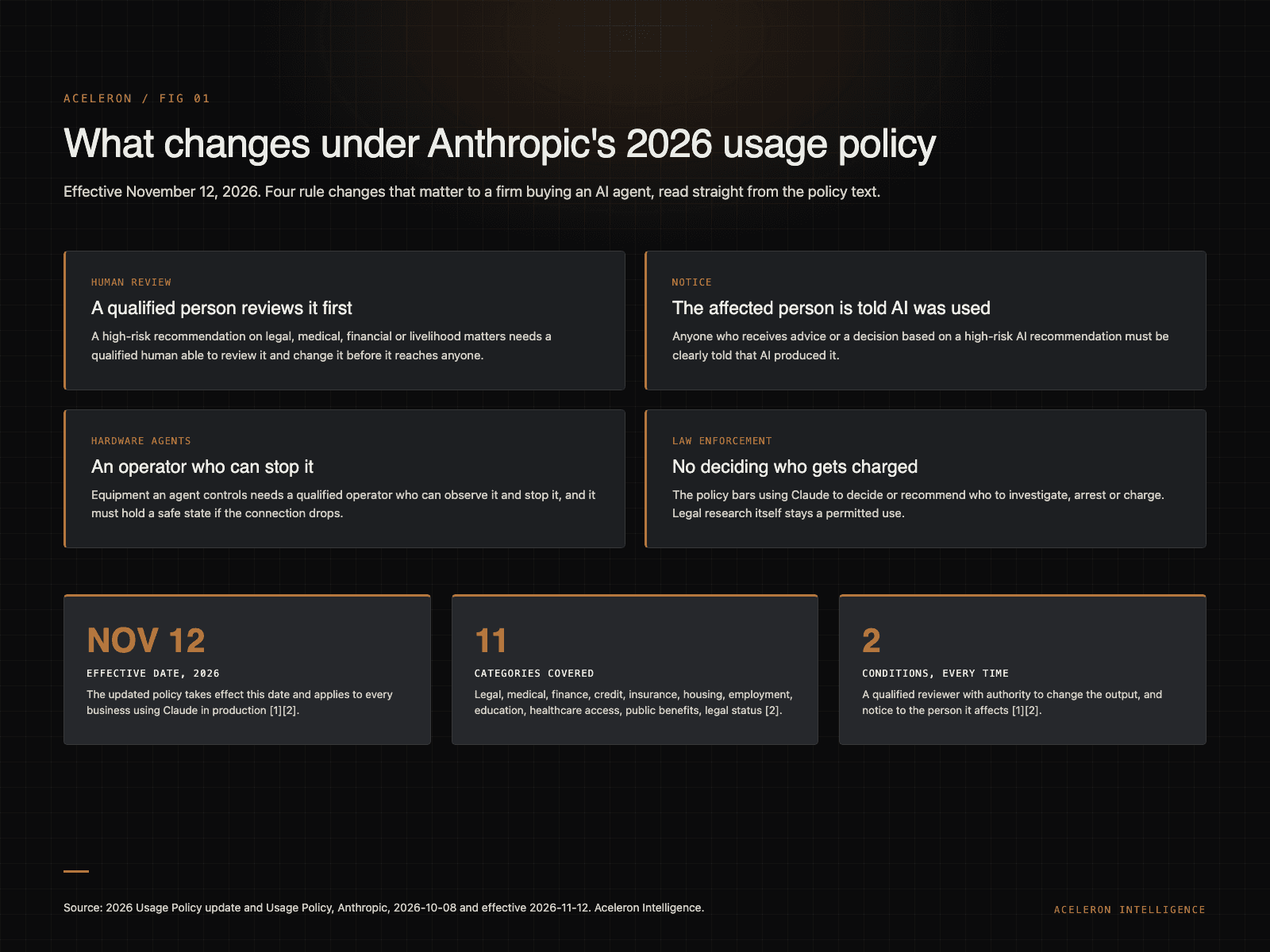
Most of the firms we talk to have already tried a general AI subscription for drafting, and the review step the new policy now spells out was already happening informally, in someone's head, with no record of it. That is the gap the policy just made explicit, and it is the same gap we build against from day one.
- Every agent we build ships with a named reviewer and a written escalation point before it ever touches a live client file.
- The AI-used notice is part of the output itself, not a policy a client has to be told about separately.
- Every review is logged, dated, and tied to who approved it, so the record exists before anyone asks for it.
- Any agent wired into physical equipment ships with the operator-stop and safe-state rule tested before go-live, not promised in a brochure.
A qualified person reviews it, with the authority to change it, and the person it affects is told AI was used. That is the whole rule, and it is also the whole build.
- Aceleron Build Team, 10.2026
How to get the most out of this
- Read the policy text once yourself, not just a summary of it. The eleven categories are specific, and most firms are surprised which of their workflows already qualify.
- Name your reviewers before November 12, not after a client asks who checked the AI's work.
- Put the notice sentence in writing, in the exact words you will use with a client. Our law firms page shows how we wire that line into the output itself.
- Treat the hardware rule as a design question, not a policy footnote, the day you connect any agent to equipment with real-world consequences.
05 / FAQ
Does Anthropic's new usage policy apply to a small firm, or only large companies?
It applies to any business using Claude, regardless of size. The high-risk categories are about what the recommendation affects, health, legal rights, finance, livelihood, or essential services, not how big the company producing it is.
What counts as a qualified human reviewer under the policy?
The policy requires someone with the actual authority to review a high-risk AI recommendation and change it before it goes out, not simply someone who glances at the output. For a law firm, that is typically the attorney of record, not a staff member with no authority to alter the advice.
Does this policy stop a firm from using AI for legal research?
No. The policy names legal research and analysis as a use that stays permitted, including by law enforcement agencies and courts, alongside content moderation and journalism, provided it is not used for the purposes the policy prohibits elsewhere [2].
What changes for a business that connects an AI agent to physical equipment?
The agent needs a qualified operator who can observe what the equipment is doing and stop it at any time, and the equipment itself has to hold a safe state if its connection to Claude is lost.
References
[1] 2026 Usage Policy update. Anthropic. 2026-10-08. https://www.anthropic.com/news/2026-usage-policy-update.
[2] Usage Policy. Anthropic. Effective 2026-11-12. https://www.anthropic.com/legal/aup.
[3] AI Risk Management Framework. National Institute of Standards and Technology. 2026. https://www.nist.gov/itl/ai-risk-management-framework.
[4] 2026 Report on the State of the US Legal Market. Thomson Reuters Institute and Center on Ethics and the Legal Profession at Georgetown Law. 2026-01-07. https://www.thomsonreuters.com/en/institute/reports/state-of-the-us-legal-market-2026.
Conclusion
Anthropic's new usage policy did not invent a new standard out of nowhere. It wrote down, in specific and checkable terms, what a careful business was already supposed to be doing: a named person reviews what an AI produces before it reaches someone's health, legal rights, or livelihood, and that person is told AI was involved. Name your reviewers, write the notice down, and the rest of November 12 is a formality.
Book a free discovery call. We map where your hours and dollars go, then hand you a customized implementation plan. No cost, no obligation, and no public cloud chatbot in the loop. Grab a 30-minute slot at book.aceleron.ai/intro-30, or start with a note on our contact page.