

An AI agent for law firm intake takes the first pass on a new inquiry, structures the facts, runs a conflicts check against your own matter archive, and hands a partner a clean file to open or decline. Done right, none of that leaves your environment.
What this covers
- Where the hours actually go in a small firm's intake
- What changes for the people doing that work
- Where the AI decides and where a person still signs off
- The ethics duties that shape the design
- The comparison against a public chatbot
What to weigh
- Where client data actually lives
- Who supervises the automated steps
- Conflicts across historical matters
- How missing information gets flagged
- The audit trail your bar counsel would want
By the end you will know where your intake hours are going, what the work looks like once an agent takes the first pass, and what to insist on from anyone who builds this for you. This piece is written by the Aceleron build team from law-firm engagements we have run in 2026.
Aceleron Intelligence builds private AI systems for law firms and local businesses in South Florida. Every claim below is cited to a primary source.
01 / The landscape
Law-firm demand and rates set records in 2025, and the industry response has been to spend on people and technology at the same time. The 2026 State of the US Legal Market report, published jointly by the Thomson Reuters Institute and the Center on Ethics and the Legal Profession at Georgetown Law, put average firm profit growth at 13 percent, demand at its best level since the Global Financial Crisis, and worked-rate growth at 7.3 percent [1]. The same report flagged that 90 percent of legal dollars still flow through hourly billing arrangements, which means the technology spend has to translate into hours a partner actually keeps [1].

Intake is the highest-leverage place to start. Every matter has to move through it, and the routine parts of it (contact capture, conflicts sweep, jurisdiction check, matter type, fee arrangement) are the same across cases. If the automation is right, the partner sees a file that is either ready to open or clearly not a fit, without spending an hour of billable time collating notes.
Where the hours actually go
A small firm intake usually splits across three roles: the front-desk person who fields the call, a paralegal who structures the file, and the partner who decides. Time studies of legal support work show the paralegal step is the one that soaks up hours [1]. That is the step a private AI agent is best at, because the work is structured, repetitive, and grounded in files the firm already has.
- Capture from web form, phone, and email
- Standardize the fact pattern into a fixed schema
- Search historical matters for name, party, and issue conflicts
- Flag missing information and route back to the client
- Produce a matter-open packet a partner can approve in one read
The point is not to remove the paralegal. It is to hand the paralegal a first pass they edit rather than assemble.
The ethics floor
Every choice below is bounded by the American Bar Association's Formal Opinion 512, which set the duty of competence, confidentiality, supervision, communication, and reasonable fees for lawyers using generative AI [2]. Florida added a state-specific overlay in Ethics Opinion 24-1, which reinforces informed consent, confidentiality, and lawyer oversight of AI output [3]. Neither opinion bans AI. Both require that a lawyer stays responsible for what the tool produces and where client information goes.
A private AI agent grounded in your own environment answers the confidentiality and supervision duties structurally. Client information never leaves your network, and the agent's output is a draft that a person confirms before it moves the file forward.
02 / How to decide
The choice most partners are actually making is between a public chatbot bolted to a web form and a private AI agent grounded in the firm's own matter archive. The two look similar in a demo. They diverge sharply the first time a real conflict shows up, or a client asks where the data went.
| Dimension | Public chatbot intake | Private AI intake |
|---|---|---|
| Where client data lives | Sent to a third-party server outside your control | Stays in your firm's environment, and never leaves it |
| Conflicts check | Not connected to your matter archive | Runs against your firm's own historical matters |
| Missing information | Guesses or invents to complete the answer | Flags gaps and routes them to a person |
| Attorney sign-off | Bypassed in the fast path | Required before any new matter opens |
| Audit trail | Prompt logs sit in a vendor cloud | Every step logged inside your practice management |
TABLE 01. PUBLIC CHATBOT INTAKE VS PRIVATE AI INTAKE.
The single spec that matters most is where the data lives. If your intake pipeline sends unredacted client facts to a vendor cloud, no amount of prompt engineering closes the confidentiality gap the ABA opinion names [2]. Fix that first, then argue about model quality.
Practical checks
- Confirm the intake system stores prompts and responses inside your network or a business associate you have a written agreement with.
- Confirm the conflicts sweep runs against your own matter archive, not against a generic training corpus.
- Confirm the agent flags any inquiry it cannot fully classify, rather than closing the ticket.
- Confirm the partner sees the matter-open packet within 5 to 15 minutes of the client's first contact, since faster response is one of the strongest signals a firm can control on lead conversion.
Read our own take on the private-versus-public trade-off on the services page and the six-row comparison it inherits from.
Public chatbot vs private AI agent
A public chatbot is a talking form. It can accept a message and reply, and if the reply sounds plausible, the visitor keeps typing. It has no view of the firm's history and no obligation to escalate.
A private AI agent is different in kind. It sits on top of the firm's practice management, reads the intake input against a structured schema, cross-checks against the archive, and produces a draft file for a real person to sign off on. It fits the partner who wants to answer a lead in minutes and still be able to defend the file at bar counsel.
03 / Where this fits
Not every firm is ready for the full pipeline on day one. The point of the tiering below is to name the workflow that will pay for itself first, then work outward as the firm's tolerance for automation grows.

- Solo and small firms, high volume, single practice area (personal injury, family, immigration): the AI agent should take the first structured pass and produce a clean matter-open packet. The partner still owns the accept-or-decline call.
- Boutique firms with a mixed practice: the agent captures and routes, then hands each matter to a specialist paralegal for the practice-specific fact pattern. The routing is the automation. The classification is a partner rule.
- Firms with an active referral network: the agent should treat inbound referrals as a distinct channel, tag the referring party, and produce a thank-you draft for the partner to send within the same day.
Starter, standard, full build
- Starter: one workflow, one practice area. Web form and phone intake feed a structured file. Conflicts run against the firm's own archive. A person approves before the matter opens. Time to first partner-approved packet drops from hours to minutes on the routine cases.
- Standard: three to five practice areas. Referral tagging, jurisdiction check, fee-agreement drafting from a template the partner already uses. Intake sits inside the firm's existing practice management (Clio, MyCase, PracticePanther), rather than replacing it.
- Full build: the intake pipeline is one of several agents in the firm. Document review and discovery drafting sit alongside it, and a live dashboard shows how many hours were recovered week over week. See the pattern we use on the dashboard walkthrough.
Making it fit your firm
- Choose the escalation trigger you actually trust. Some firms want a human on every new matter; others want automation on routine tickets and human review on high-value inquiries.
- Choose how strict the missing-information rule is. A firm that closes leads on partial forms will lose fewer inquiries but will edit more files later.
- Choose where the audit trail lives. Most firms want the trail inside the practice-management system, not in a separate vendor tool.
04 / How Aceleron builds this
Most firms we talk to have already tried a public chatbot on the website. It answered fast, it read well, and the first time a real conflict came in, it did not know. The friction is not the chat interface. It is that the chatbot cannot see the archive and cannot verify what it says.
The Aceleron approach starts with the archive, not the model.
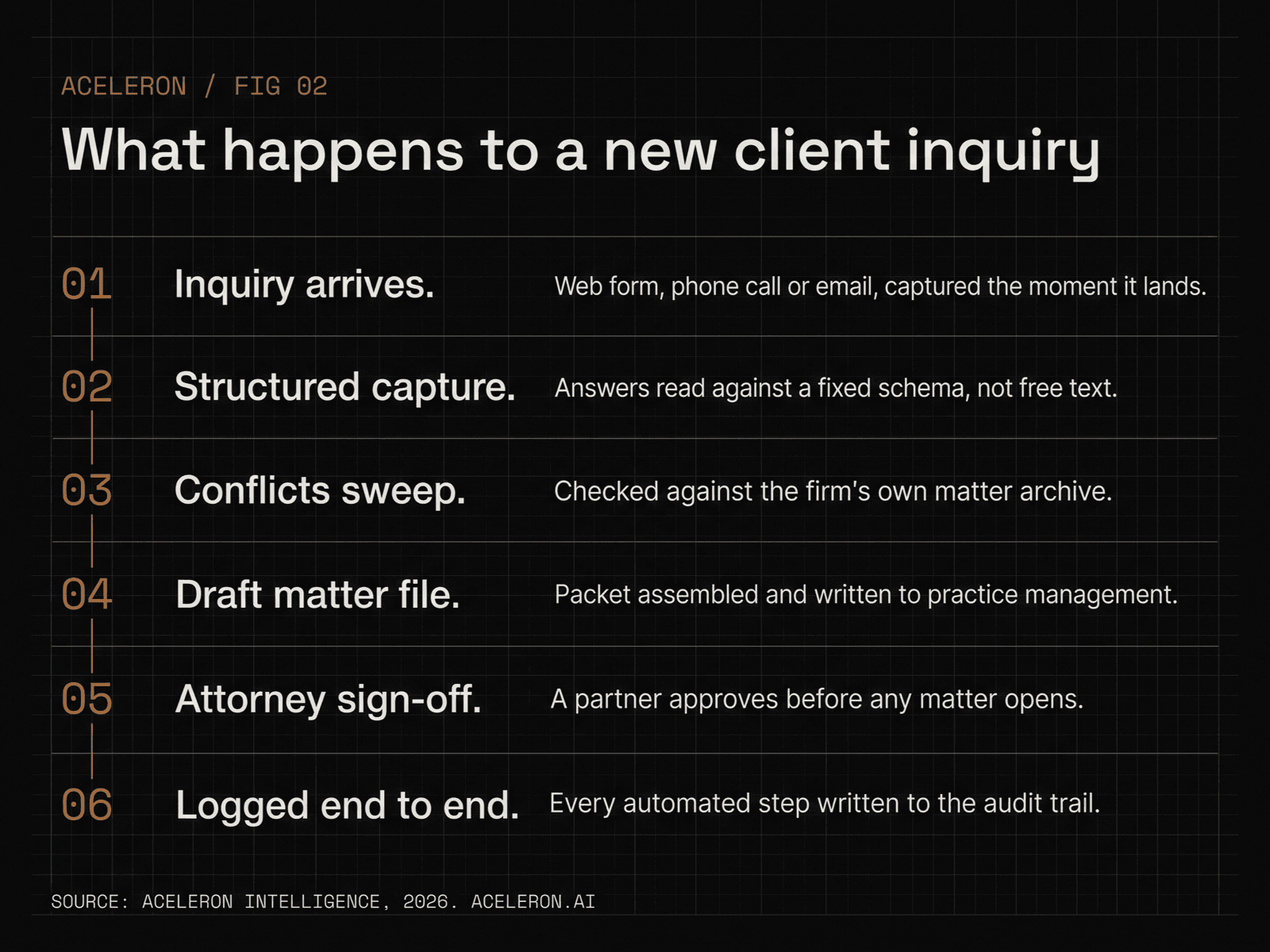
- The intake agent is deployed inside the firm's environment, so unredacted client information never crosses a public boundary.
- The conflicts sweep is anchored to the firm's own matter database, not to a generic training corpus.
- Every automated step writes to the practice-management audit log, so a bar-counsel question has an actual answer.
- The partner is a required sign-off, not a nice-to-have step the fast path can skip.
A private AI agent is different in kind, because it sits on top of the firm's practice management, reads the intake input against a structured schema, cross-checks against the archive, and produces a draft file for a real person to sign off on.
- Aceleron Build Team, 09.2026
How to get the most out of this
- Start with the workflow that already has a written checklist. If the paralegal follows a script, the agent has a target to hit; if the process is tribal, write the script first.
- Pick a single practice area for the pilot. Cross-cutting rules muddy the win and stretch the timeline.
- Turn on the audit log from day one. If a partner cannot open a matter and see every automated step, the pilot fails the ethics test before it fails the speed test.
- Track the two numbers that matter: minutes to first partner-approved packet, and rate of missed-information routing. Anything else is decoration. Watch these on the dashboard walkthrough.
05 / FAQ
Does using an AI agent violate attorney-client confidentiality under Rule 1.6?
Not by itself. The ABA's Formal Opinion 512 explicitly permits the use of generative AI in a lawyer's practice, on the condition that the tool protects client information, that a lawyer supervises the output, and that fees remain reasonable [2]. A public chatbot on a vendor server without a written confidentiality arrangement is the risk, not the concept of AI itself. A private deployment inside the firm's own environment sidesteps that pattern.
How long does a firm-intake pilot usually take to ship?
The intake pipeline in a single practice area typically ships inside four to eight weeks for a small firm. The gating factors are how clean the existing intake questionnaire is, how well the practice-management data is tagged for conflicts, and how many partners have to sign off on the escalation rule. None of those requires new hardware for a firm that has already invested in laptops in the last two years.
Do we still need a paralegal on intake if the AI agent runs it?
Yes. The agent handles capture, structuring, and the first-pass conflicts sweep. The paralegal reviews the packet, resolves anything the agent flagged, and calls the client back for missing detail. A well-scoped intake agent should return the paralegal three to five hours a week in a busy firm, not replace the role.
What happens when the agent is unsure?
By design, the agent does not close the ticket. It flags the specific field it cannot fill, routes the inquiry to the paralegal (or the on-call partner for high-value matters), and writes the state to the audit log so nothing is lost. Our standing rule is that missing information routes to a person, never to a plausible guess.
Does the AI ever open a matter without a lawyer?
Never at Aceleron. Every new matter requires a partner sign-off before it opens in the practice management. That is a design choice, not a marketing line, and it maps directly to the supervisory duty the ABA opinion names [2].
References
[1] 2026 Report on the State of the US Legal Market. Thomson Reuters Institute and Center on Ethics and the Legal Profession at Georgetown Law. 2026-01-07. https://www.thomsonreuters.com/en/institute/reports/state-of-the-us-legal-market-2026.
[2] Formal Opinion 512: Generative Artificial Intelligence Tools. American Bar Association Standing Committee on Ethics and Professional Responsibility. 2024-07-29. https://www.americanbar.org/content/dam/aba/administrative/professional_responsibility/ethics-opinions/aba-formal-opinion-512.pdf.
[3] Florida Bar Ethics Opinion 24-1: Lawyers' Use of Generative Artificial Intelligence. The Florida Bar. 2024-01-19. https://www.floridabar.org/etopinions/opinion-24-1/.
Conclusion
The intake step decides how a matter starts, and how a matter starts sets the ceiling on how efficiently it runs. A private AI agent takes the first pass, keeps the client information inside the firm, and gives the partner a clean file to open or decline. Every duty the bar names still sits on the lawyer, exactly where it belongs.
Book a free discovery call. We map where your hours and dollars go, then hand you a customized implementation plan. No cost, no obligation, and no public cloud chatbot in the loop. Grab a 30-minute slot at book.aceleron.ai/intro-30, or start with a note on our contact page.